Image Outlier Detection: Mahalanobis Distance
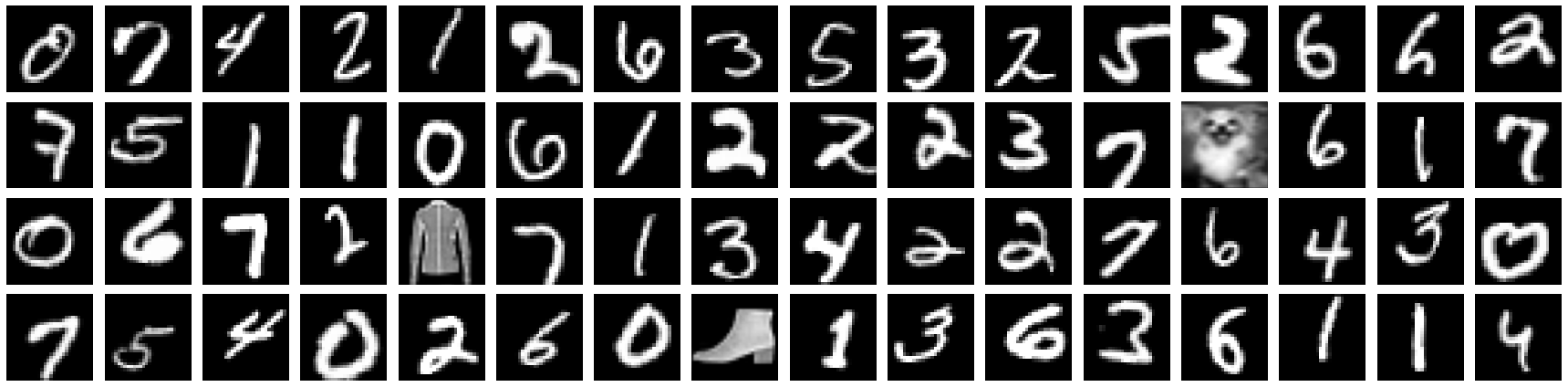
In this post, I will discuss how Mahalanobis distance (MD) can be used to detect image outliers from MNIST handwriting digits dataset as an example. Outliers are basically those sample images that don’t belong to a certain population in our training samples. Here we are particularly interested to identify those known or unknown populations that are out-of-distribution and are considered potentially as extreme cases for deployed machine learning models.
Access to the entire script and more is available via this jupyter notebook.
Importance of outlier detection
Deep neural networks (NNs) are powerful algorithms that have recently achieve impressive accuracies in various domains as wide as bioinformatics, disease diagnosis, waste management, and material novel material discovery. However, due to their intrinsic black box architecture, NNs exhibit an inclination to produce overconfident predictions and perform poorly on quantifying uncertainty. If an AI algorithm makes overconfident incorrect predictions then the consequences can be harmful or even catastrophic, for instance in the context of healthcare.

This is exactly where outlier detection (OD) becomes crucial for practical applications by helping us to identify anomalies that are drawn far away from the distribution of the training samples and avoiding potentially wrong predictions.
Note: We are mainly interested in detecting out-of-distribution samples but those are not the only types of outliers. More about different types of outliers can be found here.
Outlier detection is in addition used to assess and improve the robustness of an AI model on out-of-distribution samples which results in increased generalization of developed AI models after deployment.
Mahalanobis distance
Assume having a $N$ dimensional multivariate space that $N$ basically indicates the number of variables. Each sample in this space is represented by a point and it is a vector $x=(x_1, x_2, …, x_N)^T$. Then the Mahalanobis distance $D$ of any point $x$ is defined as the relative distance to the centroid of data distribution and it is given by
\[D(x) = \sqrt{ (x - \mu)^T V^{-1} (x - \mu) },\]where $\mu$ and $V$ are the mean and covariance matrix of the sample distribution, respectively.
The larger $D(x)$, the further away from the centroid the data point $x$ is.
A sample is identified as an outlier if its evaluated Mahalanobis distance, namely outlier score, is larger than a hard threshold obtained from the training inlier samples. The threshold, in this post, is defined as $\mu + 2 \sigma$ where $\sigma$ is the standard deviation.
Feature space
Mahalanobis distance (MD) analysis can be directly applied to the image data. It is however better to be applied on feature space which is in fact an alternative representation of the original image data in smaller dimensions encoded by a neural network. Any point in this space not only describing individual pixels but also intrinsically the appearance and relevant patterns for the labels present in the sample.
The figure below shows a schematic view of a neural network which encodes an input images to a feature space. The feature extractor in fact is a representation of the original images but in a reduced dimension $x$.

Code description
In what follows, I will explain important steps on how to implement the MD outlier detection in python using tensorflow.keras which basically contains the data preparation, feature encoder, Mahalanobis outlier detector, and finally some results.
Access to the entire script and more is available via this jupyter notebook.
Data preparation
First of all, we rescale image data between [-1.0, 1.0] and intentionally using an image data generator from the input numpy array.
The data generator is not necessary in this case as the size of the studied datasets is small (i.e. few megabytes).
However, in the real-world problem, we often work with big data which the entire dataset can not be fitted to the memory at once. An image data generator is a great tool that helps us to deal with a vast number of images for different tasks such as preprocessing, augmentation, training, and validation.
Image data generator
The below script shows the definitions of image-related functions to create an image data generator from the input image (X) and label (y) data.
We use image augmentations, creating a modified versions of images by randomly applying a range of transformations, to reduce the chance of over-fitting while training the feature model.
Keras ImageDataGenerator takes various image transformations (e.g. rightness, rotation, zoom) as input arguments.
The one-hot encoding is further used for the image labels.
The latter basically creates a binary column for each digit.
def scale(img):
    """
    Scale input image between [-1.0, 1.0].
    """
    return img.astype(np.float32)/127.5 - 1.0

def unscale(img):
    """
    Unscale input image between [0, 255].
    """
    return ((img+1.0)*127.5).astype(np.uint8)

def preprocess_image(img):
    """
    Preprocess function for image data generator.
    """
    img = scale(img)
    return img

def create_datagen(X, y, aug=False, onehot=False):
    """
    Create an image data generator from input images.
    """
    # Apply augmentation
    if aug:
        datagen = tf.keras.preprocessing.image.ImageDataGenerator(
            rescale=None,
            preprocessing_function=preprocess_image,
            shear_range=0.1,
            zoom_range=0.1,
            height_shift_range=0.1,
            width_shift_range=0.1,
            rotation_range=10,
            brightness_range=[0.7, 1.3],
            fill_mode= "nearest",
        )
    else:
        datagen = tf.keras.preprocessing.image.ImageDataGenerator(
            rescale=None,
            preprocessing_function=preprocess_image,
        )

    # One-hot encodeing
    labels = y if not onehot else tf.keras.utils.to_categorical(y)

    # Create data generator from numpy arrays (X, y).
    batches = datagen.flow(X, labels, batch_size=CFG['batch_size'], shuffle=True)
    batches.samples = X.shape[0]

    return batches
Datasets
The utility function get_dataset() helps us to easily load different datasets (i.e. MNIST, fashion MNIST, CIFAR10) for both feature model training and outlier detector validation.
  def get_dataset(name="mnist"):
    """
    Return the entire dataset as a tuple (X, y).
    We need it to explicitly define the outlier population.
    """
    if name=="mnist":
        (X_train, y_train), (X_test, y_test) = tf.keras.datasets.mnist.load_data()
    elif name=="fashion_mnist":
        (X_train, y_train), (X_test, y_test) = tf.keras.datasets.fashion_mnist.load_data()
    elif name=="cifar10":
        (X_train, y_train), (X_test, y_test) = tf.keras.datasets.cifar10.load_data()
    else:
        raise ValueError(f"Unknown dataset {name}")

    X = np.concatenate((X_train, X_test), axis=0)
    y = np.concatenate((y_train, y_test), axis=0)

    # Add channel dimension for gray images
    if X.ndim < 4:
        X = X[..., np.newaxis]
        y = y[..., np.newaxis]

    return X, y
It might be asked why we need to concatenate the training and test datasets.
The answer is that, only for testing purposes, we are interested in explicitly defined a known outlier population (i.e. samples with label 9, 8).
This can be done by separating them from the entire dataset and then splitting the rest into the training and test sets.
We further considering two Fashion MNIST and CIFAR10 datasets as completely external set of unknown outliers.
X, y = get_dataset()

# Set some of categories as outliers and the rest for training classifier
outlier_indices = np.squeeze( (y==9) | (y==8) )
X_outliers, y_outliers = X[outlier_indices], y[outlier_indices]
X_inliers, y_inliers = X[~outlier_indices], y[~outlier_indices]

# Split train test
X_train, X_test, y_train, y_test = train_test_split(X_inliers, y_inliers, test_size=0.20, random_state=2021)
num_labels = len(np.unique(y_train))
Bringing all together, we have eventually three sorts of data:
- training and test sets which contain image labels
0to7 - known outlier set which contains image labels
8and9 - unknown outliers belong to completely external datasets
Fashion MNISTandCIFAR10

Note: The training and test sets have no samples from the outlier set. This means the later trained model doesn’t know anything about outlier sets. This provides us a set of outliers to validate our outlier detector.
Feature extractor model
For feature extractor model, we need to build a NN classifier model which contains two main parts:
- Feature extractor
- Top softmax layer
After training the classifier using provided image labels. we will use the feature extractor part which already contains the trained weights. This way, all the relevant features from training samples learned by the feature extractor and therefore is used for the outlier detection.
Building feature extractor
We build the feature extractor model by employing a deep neural network that contains a few sequences of convolutional layers and a dense layer on the top.
The extended classifier model then is built using an additional dense layer with softmax activation functions.
INFO: Transfer learning is an alternative approach for developing a more advanced feature mapping instead of using the plain convolutional layers as discussing here.
def build_custom_model():
    """
    Build a convolutional classifier that is used as the image features extractor.
    """
    conv_regulizer = tf.keras.regularizers.l2(CFG['conv_regularization_factor'])
    dense_regulizer = tf.keras.regularizers.l2(CFG['dense_regularization_factor'])
    # Convolutional layers
    inp = layers.Input(shape=(CFG['image_size'], CFG['image_size'], CFG['channel_size']))
    x = inp
    for filters in CFG['layer_filters']:
        x = layers.Conv2D(filters, CFG['kernel_size'], padding='same', activation='relu', kernel_regularizer=conv_regulizer)(x)
        x = layers.AveragePooling2D((2, 2), padding='same')(x)
    # Top dense layers
    x = layers.Flatten()(x)
    x= layers.Dropout(0.2)(x)
    features = layers.Dense(64, activation='sigmoid', kernel_regularizer=dense_regulizer)(x)
    out = layers.Dense(num_labels, activation='softmax', kernel_regularizer=dense_regulizer)(features)
    # Return classifier, features extractor
    return Model(inp, out), Model(inp, features)
Note: Sigmoid activation function is used to map the output range of the feature extractor between [0, 1].
Please note that the build_custom_model() function returns two models with the shared set of weights:
1) classifier model 2) future extractor.
Fitting feature extractor
To find the right values of weights in the feature extractor model, the focus should be on the classifier model. We, therefore, compile the classifier using adam optimizer and `categorical cross-entropy loss function. Afterward, the training and validation batches are used to fit the classifier model.
# Create NN which contains classifier and feature models
clf, fm = build_custom_model()

# Compile only the classifier, the one that has to be trained
clf.compile(optimizer="adam", loss='categorical_crossentropy', metrics=['accuracy'])

# Create training and validation image data generators
train_batches= create_datagen(X_train, y_train, aug=True, onehot=True)
val_batches = create_datagen(X_test, y_test, onehot=True)

# Fit classifier model
clf.fit(
    train_batches,
    steps_per_epoch=train_batches.samples//CFG['batch_size'],
    validation_data=val_batches,
    validation_steps=val_batches.samples//CFG['batch_size'],
    epochs=CFG['epochs'],
    callbacks=callbacks,
    workers=8,
    verbose=1,
 )
Mahalanobis outlier detector
If everything goes well, we should eventually have a (well-)trained feature model which extracts important features from the input image and map them to the feature space.
As the next step, we define a custom Mahalanobis outlier detector that accepts a pre-trained feature extractor model as an input, and having fit and predict methods.
class MahalanobisOutlierDetector:
    """
    An outlier detector which uses an input trained model as feature extractor and
    calculates the Mahalanobis distance as an outlier score.
    """
    def __init__(self, features_extractor: Model):
        self.features_extractor = features_extractor
        self.features = None
        self.features_mean = None
        self.features_covmat = None
        self.features_covmat_inv = None
        self.threshold = None

    def _extract_features(self, gen, steps, verbose) -> np.ndarray:
        """
        Extract features from the base model.
        """
        if steps is None:
            steps = gen.samples//CFG['batch_size']
        return self.features_extractor.predict(gen, steps=steps, workers=8, verbose=1)

    def _init_calculations(self):
        """
        Calculate the prerequired matrices for Mahalanobis distance calculation.
        """
        self.features_mean = np.mean(self.features, axis=0)
        self.features_covmat = np.cov(self.features, rowvar=False)
        self.features_covmat_inv = scipy.linalg.inv(self.features_covmat)

    def _calculate_distance(self, x) -> float:
        """
        Calculate Mahalanobis distance for an input instance.
        """
        return scipy.spatial.distance.mahalanobis(x, self.features_mean, self.features_covmat_inv)

    def _infer_threshold(self, verbose):
        """
        Infer threshold based on the extracted features from the training set.
        """
        scores = np.asarray([self._calculate_distance(feature) for feature in self.features])
        mean = np.mean(scores)
        std = np.std(scores)
        self.threshold = mean + 2 * std
        if verbose > 0:
            print("OD score mean:", mean)
            print("OD score std :", std)
            print("OD threshold :", self.threshold)

    def fit(self, gen, steps=None, verbose=1):
        """
        Fit detector model.
        """
        self.features = self._extract_features(gen, steps, verbose)
        self._init_calculations()
        self._infer_threshold(verbose)

    def predict(self, gen, steps=None, verbose=1) -> np.ndarray:
        """
        Calculate outlier score (Mahalanobis distance).
        """
        features  =  self._extract_features(gen, steps, verbose)
        scores = np.asarray([self._calculate_distance(feature) for feature in features])
        if verbose > 0:
            print("OD score mean:", np.mean(scores))
            print("OD score std :", np.std(scores))
            print(f"Outliers     :{len(np.where(scores > self.threshold )[0])/len(scores): 1.2%}")

        if verbose > 1:
            plt.hist(scores, bins=100);
            plt.axvline(self.threshold, c='k', ls='--', label='threshold')
            plt.xlabel("Mahalanobis distance"); plt.ylabel("Distribution");
            plt.show()

        return scores
Fitting detector
Calling the fit method on training batches basically calculates the required mean, covariance matrix, and some statistics including threshold of Mahalanobis distance for inlier samples.
# Create and fit Mahalanobis outlier detector
od = MahalanobisOutlierDetector(features_extractor=fm)
od.fit(train_batches, steps=None, verbose=1)
Detector predictions
The predict method calculates the Mahalanobis distances as outlier scores for any given input batches on sample level.
This allows us to calculate the outlier score for the training and validation sets using:
od_scores = od.predict(val_batches, verbose=2)
More interestingly, we can calculate the scores for the defined known outlier population.
outlier_batches = create_datagen(X_outliers, y_outliers)
od_scores = od.predict(outlier_batches, verbose=2)
Samples from Fashion Fashion MNIST and CIFAR10 datasets are considered as unknown outliers and using the predict method we can calculate their outlier scores.
Results and conclusions
We are eventually going to validate our fitted MD outlier detector on different populations of the MNIST dataset and two external datasets including Fashion MNIST and CIFAR10 to check how well it performs on the task aimed at detecting outliers. The obtained results are presented in the below table.
| Subset | Detected outlier | Mean score | Std score | Threshold | Samples |
|---|---|---|---|---|---|
| MNIST (training) | 2.52% | 7.78 | 1.72 | 11.50 | 44960 |
| MNIST (validation) | 2.73% | 7.51 | 1.71 | 11.50 | 11212 |
| MNIST (outlier) | 23.26% | 10.39 | 1.63 | 11.50 | 13760 |
| Fashion MNIST | 59.62% | 11.79 | 2.1 | 11.50 | 69968 |
| CIFAR10 | 24.74% | 10.35 | 1.79 | 11.50 | 60000 |
Firstly, it is interesting to note that the Mahalanobis detector only detects 2.52% of the population as outliers for the training MNIST samples. It expectedly gives a similar value of 2.73 for the validation samples.
However, it detects more outliers for the MNIST outlier, Fashion MNIST, and CIFAR10 datasets with corresponding values of 23.26%, 59.62%, and 24.74%.
This tells us that the Mahalanobis OD enables us to detect outliers either they exist within the studied dataset or completely external datasets.
Secondly, the mean outlier score (i.e Mahalanobis distance) is found to be larger for outliers than those inliers of which used for training and test sets.

Further insights can be obtained by considering the distributions of the scores and focusing on the overlapping samples as shown in the next figure which is in fact the overlaid box and violin plots of the outlier score for different populations of MNIST (training), MNIST(validation), MNIST (known outlier), Fashion MNIST (unknown outlier), and CIFAR10 (unknown outlier). The figure reveals that there exist still some outliers that their score is small as compared with the inlier scores, Or samples within the training sets of which their scores is beyond the threshold. This basically means that Mahalanobis detector unable to identify all outliers but fraction of them and thus working to some extent.

The corresponding histogram plot of the outlier scores represents better the overlap regions.
Nevertheless, detecting the shifts in data distribution due to outliers is pretty much obvious in the two previous figures.

INFO: The jupyter notebook of the discussed script in this post can be found here.


